PlutusDoc Lifetime Deal – AI Agents Run Your Contracts
Sending a contract is easy. The waiting is the hard part.
You send it Monday, and by Thursday you hear nothing. Did they open it? Did it go to spam? Did you forget a signature field? Nobody tells you.
That is what PlutusDoc fixes. E-signing has worked for years. The messy work around it has not. Most tools hand you a chat box. It answers your questions, then hands the job back to you.
PlutusDoc works the other way. Plutus, the agent inside, holds the same nineteen actions you do. It drafts the document and fills in the blanks. It checks if the document is ready, then sends it. It chases anyone who goes quiet. Then it stops and waits for you to approve.
Nothing leaves your account until you say yes. The PlutusDoc Lifetime Deal is live on AppSumo now. Here is what you get.
Features of the PlutusDoc Lifetime Deal
Plutus
The agent inside the app. It writes the draft. It fills in the blanks. It adds the people who must sign. It checks if the file is ready. It also tells you where a quiet deal stopped. But it waits for your yes before it creates, edits, or sends.
Your agents
PlutusDoc runs its own MCP server. OAuth 2.1 sits behind it. Point Claude, ChatGPT, Copilot, Gemini, Cursor, or your own agent at it. Then approve it on one screen. New links start with read access only.
The action layer
The app has nineteen actions in one list. They cover documents, reminders, and analytics. They also cover contacts, teams, and your calendar. Plutus uses that list. Your MCP clients use it. Your own code uses it too.
The editor
Drag a field onto the page. Then give it to a role. You can pick a signature, initials, name, job title, or company. You can also pick a date, a number, an amount, or a checkbox. Placeholders pull from the person you send it to. You can draw on a PDF you upload. You can rotate it. You can save it as a copy or over the old one.
Governance
Seven of the nineteen actions stop and wait for you. Ten scopes are given one at a time. You can cut off any client, key, or link. Every view, download, and signature is logged. So is every agent action. Each one shows the time, the IP address, and the device.
Pros of PlutusDoc
- Less chasing, fewer dead deals: You can see who opened your contract. You can see who went quiet. And when one gets stuck, you get a clear reason. No more digging through the file yourself.
- Caught before it goes out: Empty fields get flagged first. So you stop sending contracts that were never ready.
- Still your decision: The work gets done for you. But nothing goes out until you say yes.
- Proof you can show later: Months later, you still have the record. It shows the time, the device, and the address. Not a chat log nobody can find.
- One place, not five: Contacts, reminder emails, booking pages, and signatures sit in one spot. You do not need four tools.
- Nothing typed twice: Names and emails stay on file. The details fill in on their own. So one draft covers every deal you send.
Cons of PlutusDoc
- Very New Company: PlutusDoc started on June 20, 2026. The team is just 1 to 10 people. And there are no reviews yet. So you are buying a tool with almost no track record.
- AI Credits Cost Extra: Extra Plutus credits are billed on their own. So if you lean on the agent a lot, you will pay more than the deal price.
- Lower Cap Than Monthly Plan: Tier 1 gives you 120 sent documents a month. The regular $20 plan gives 249. So the lifetime deal has a tighter limit than the paid plan it maps to.
- No Ready Integrations: The only listed integrations are an API and webhooks. So linking PlutusDoc to your other tools means building that link yourself.
Who is PlutusDoc best for?
- Freelancers: You send contracts one at a time, between real client work. So it helps to know who opened yours. And who went quiet. Now you do not have to check in every few days.
- Real estate agents: Leases and renewals carry the same names, dates, and amounts. You need to know the file is complete. And you need to know it before a tenant or buyer sees it.
- Sales managers: You have deals sitting in many stages at once. You want to know where each one stopped. Don’t ask your team for updates.
- Small teams with no legal help: Nobody on your side writes contracts for a living. So a ready-made offer letter or NDA helps. So does keeping your own wording on file. Both beat staring at a blank page.
- People already using AI assistants: You spend your day inside Claude or ChatGPT. You would rather ask your own helper to handle a contract. Not open one more tab.
PlutusDoc AppSumo Pricing Plan
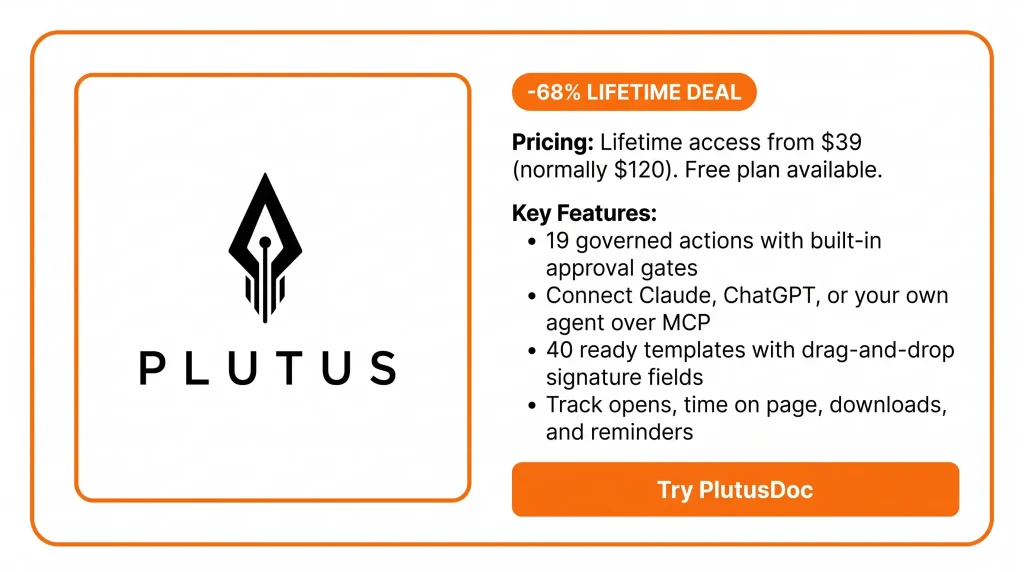
License Tier 1 — $39 (was $120)
- Send 120 documents a month
- Make as many drafts as you like
- Signing and reminders
- See your payments and your usage
- Pay once, keep it for life
- All new Professional plan updates
License Tier 2 — $99 (was $1,200)
- All of Tier 1, plus:
- No limit on documents sent
- New Enterprise plan updates instead
5 BEST PlutusDoc Alternatives (Comparison)
PlutusDoc vs DocuSign
Most people think of this one first. It signs documents well. But it counts every send as an “envelope.” And those run out fast.
- Price: Personal is $10 a month, paid yearly. Standard is $25 per user. Business Pro is $40 per user.
- Limits: Personal gives you 5 envelopes a month. Standard and Business Pro give 100 per user per year. That works out to about 8 a month.
- Note: There is a trial, but no free plan. So you really start at $120 for the year.
- Best for: Teams whose clients already know the name
PlutusDoc vs PandaDoc
This one is built for sales proposals more than plain contracts. Good if your papers need to look sharp and sell something.
- Price: Free plan. Starter is $19 per user per month. Business is $49.
- Limits: The free plan stops at 5 documents a month. Each extra one costs $3.
- Note: API access, bulk sending, web forms, and notary work all cost more on top.
- Best for: Sales teams sending quotes, not just contracts
PlutusDoc vs Dropbox Sign (formerly HelloSign)
The simplest of the big three. Paid plans do not count your documents. That makes the bill easy to guess.
- Price: Essentials starts at $15 a month for one user. Standard is $25 per user.
- Limits: The free plan gives 3 requests a month. Paid plans have no cap.
- Note: The SharePoint link was shut off in March 2026.
- Best for: Solo workers who just want signing and nothing more
PlutusDoc vs SignWell
The cheapest way for one person to send a lot. Plain, but it works.
- Price: Free plan. Light is about $10 a month. Business is $30 paid yearly, or $36 each month.
- Limits: Free gives 3 documents a month. Light is one user with no cap. The API gives 25 free per month, then you pay per use.
- Note: There is no phone app.
- Best for: Freelancers who send a lot and want a small bill
PlutusDoc vs Documenso
Open source. You can run it on your own server. The software itself costs nothing.
- Price: Free hosted plan. Individual is $25 a month, paid yearly. Teams is $40 a month for 5 users. Platform is $250 a month.
- Limits: The free hosted plan stops at 5 documents a month.
- Note: Self-hosting is free under AGPL-3.0. But that licence still holds if you build it into a product you sell.
- Best for: Coders who want their own server and their own code
Final Thoughts – PlutusDoc Review 2026
Here is the moment that sold me.
I asked it to draft an NDA. It pulled my template. It filled in the name. It added the person. Then it stopped and waited. That pause is the whole product.
Later I asked if a lease was ready. It found two problems. The rent box was empty. And one signature field was missing. It read the file itself. I would have caught both in the end. But only after the tenant emailed to ask what was going on.
The rest holds up. Forty templates, so you never start blank. Each person gets their own link. So you see who opened it and who sat on it. Every step is logged with the time, the address, and the device. You can also point Claude or ChatGPT at it. Then run your contracts from where you already work.